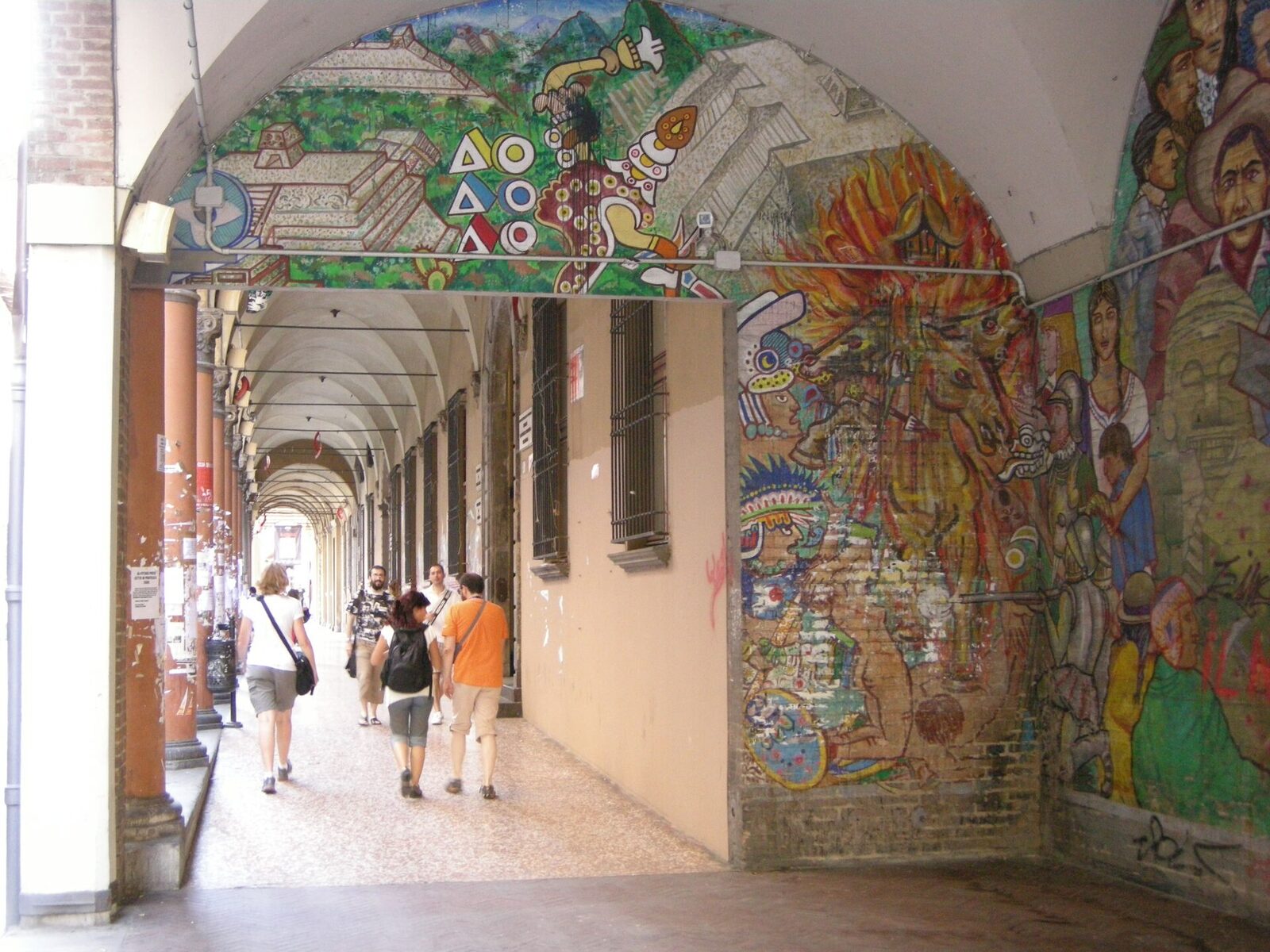
Via Zamboni & the University Quarter
The street that runs from the Two Towers into the beating heart of Europe's oldest university, equal parts medieval porticoes, free museums and student bars.
Via Zamboni is the spine of Bologna's university quarter, the "zona U." It starts right under the leaning towers and runs about a kilometre northeast to Porta San Donato, one of the old city gates. Walk it end to end in 20 to 30 minutes, or stretch it into a slow half-day of museums, churches and coffee stops. This is where you see Bologna without the day-trippers.
- Length
- ~1 km
- Walking time
- 20–30 min (no stops)
- Starts
- Two Towers / Via Rizzoli
- Vibe
- Student, low-key, museums
The University of Bologna has been running here since 1088, which makes it the oldest university in continuous operation in Europe. You feel it on Via Zamboni: the buildings are faculties and libraries, the porticoes are lower and narrower than the grand ones around the main square, and the people on them are mostly under 25. It is a working neighbourhood, not a museum-piece, and that is the point.
On this page
Where the walk begins
Stand at the foot of the Asinelli and Garisenda towers at Piazza di Porta Ravegnana and look northeast. The street peeling off there is Via Zamboni. Within the first hundred metres the crowds thin out and the porticoes get older and more crooked, many of them genuinely medieval. You are walking the same route students have taken to class for the better part of a thousand years.
San Giacomo Maggiore and Santa Cecilia
Early on the left you reach the Church of San Giacomo Maggiore, founded in 1267. Slip inside for the Bentivoglio chapel, frescoed by Lorenzo Costa for the family that ran Bologna in the 15th century. Next door is the small Oratorio di Santa Cecilia, with a fresco cycle from around 1506. It keeps short and irregular hours, so treat it as a lucky find rather than a fixed stop. Both are free.
Palazzo Poggi and the university museums
The big draw on Via Zamboni is Palazzo Poggi, the historic seat of the university. Today it holds a cluster of free museums that are genuinely strange in the best way: an old anatomical collection with wax and clay models, early maps and astronomical instruments, ships, and cabinets of natural history. It is the kind of place you wander into expecting ten minutes and lose an hour. Check current opening days before you go, since university museums often close on Mondays and over holidays.
If the anatomy theme grabs you, the more famous carved-wood theatre sits a few minutes away inside the Archiginnasio, the university's earlier home off Piazza Maggiore. The two pair well in one afternoon.
Local tip
Most of Palazzo Poggi's collections are free, but hours shift with the academic calendar and some rooms close without much warning. Check the official university museum hours the day you plan to visit, and aim for late morning when everything that opens is actually open.
Piazza Verdi and the Teatro Comunale
Midway along, Via Zamboni opens onto Piazza Verdi, the social heart of student Bologna. By day it is benches, bikes and coffee. By night it is the loudest corner of the city, with the bar crawl spilling across to Via Petroni and Piazza Aldrovandi. On the square stands the Teatro Comunale, Bologna's opera house, designed by Antonio Galli Bibbiena and opened in 1763. You can usually only see the inside on a performance night or a scheduled tour, so check the season programme if a night at the opera appeals.
This is also the easiest place on the walk for a proper sit-down coffee or an aperitivo. Prices here are student prices, which is to say cheap by Italian-city standards.
The far end and the Pinacoteca Nazionale
Past Piazza Verdi the street rolls on toward Porta San Donato, passing the medieval Torresotto di San Vitale gate-tower. Just off the top end, on Via delle Belle Arti, sits the Pinacoteca Nazionale, the city's main art gallery. It fills a former seminary with Bolognese masters including Guido Reni and the Carracci. If you only have time for one indoor stop on this walk and you like painting, make it this one.
See the university quarter with a guide
A walking tour of the centro storico ties the towers, the porticoes and the university quarter together with the stories that make them stick, and most include skip-the-line tower access.
Browse Bologna walking toursWhen to go and how it connects
Go in term time if you want the buzz: roughly October to May, minus the exam and holiday lulls. In high summer the students are gone and Piazza Verdi feels half-asleep, though the museums and churches stay open. Mornings are best for the indoor sights, early evening for the aperitivo crowd.
Via Zamboni slots neatly between Bologna's other big sights. It starts at the leaning towers, a two-minute walk from the main square and the unfinished basilica. Loop back south and you hit the courtyards of the Seven Churches, or dive west into the food lanes of the old market district when hunger strikes. The whole area is part of Bologna's UNESCO portico network, so you barely touch sun or rain the entire way. For the wider story behind the institution, see our guide to Europe's oldest university.
Hungry after the walk? The university quarter is full of cheap, good eating, but the classic spots run through our where to eat in Bologna guide. Need a base nearby? Staying around the towers or Via Zamboni puts everything on foot.
Stay in the university quarter
Book a room near the towers and Via Zamboni and you can walk to almost every sight in the centro storico in under fifteen minutes.
Find hotels near Via Zamboni