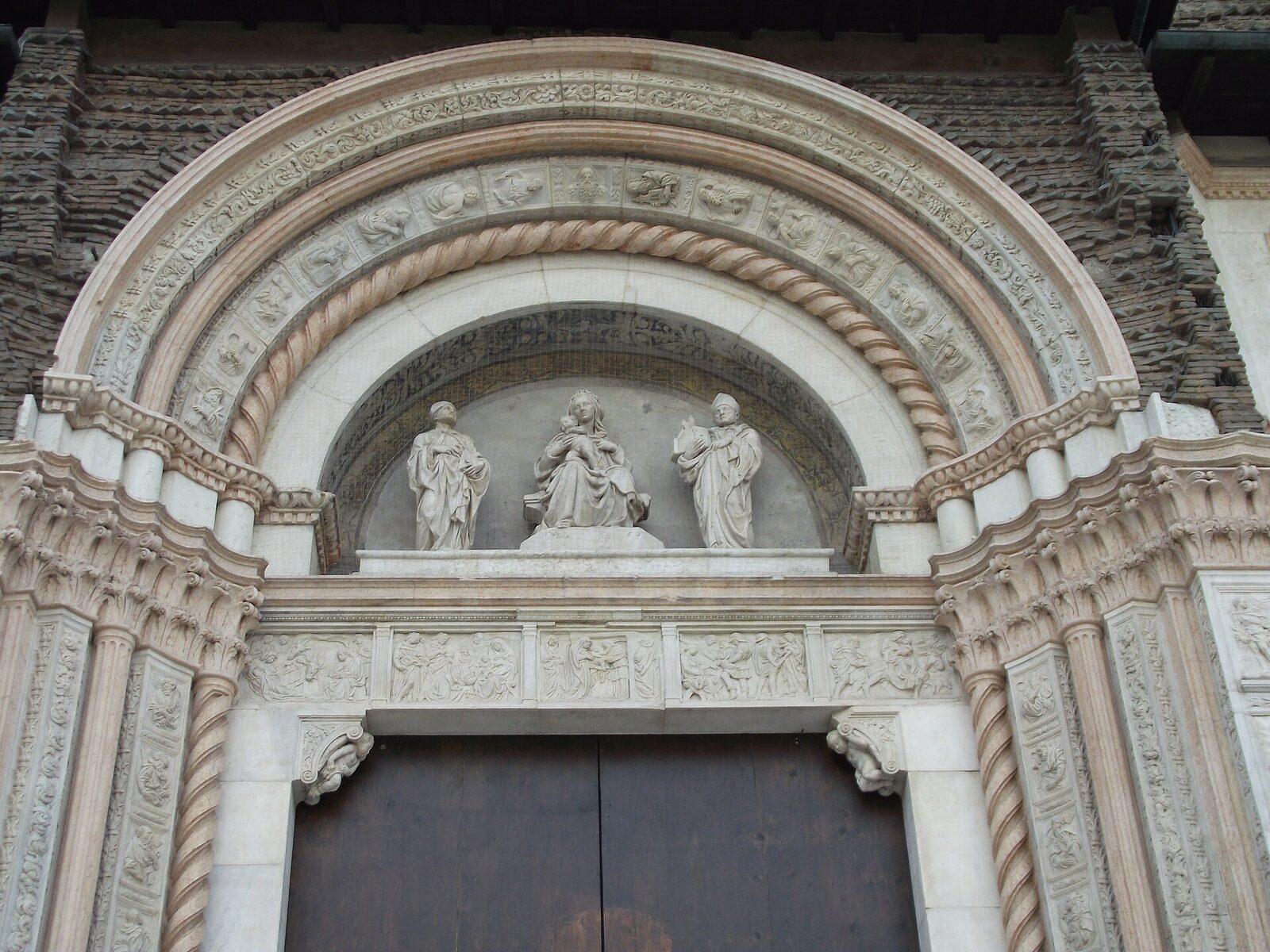
Basilica di San Petronio
The enormous half-brick, half-marble church on Piazza Maggiore was meant to be bigger than St Peter's in Rome. It never got finished, and that's exactly why it's worth a look.
San Petronio dominates the south side of Piazza Maggiore, and the first thing you notice is that something is off. The bottom third of the facade is dressed in pink and white marble. Everything above it is bare brick. Bologna started building this church in 1390 and simply never finished the front, and after more than 400 years nobody is in a hurry to fix it. Entry is free, so you can walk straight in off the square.
- Where
- Piazza Maggiore
- Entry
- Free (small fee for chapels)
- Size
- ~132m long · 6th largest in Europe
- Time needed
- 20–40 min
Why the facade was never finished
The plan was outrageous. Bologna wanted the biggest church in Christendom, larger than St Peter's, and it was a civic project paid for by the citizens rather than the Church. That ambition is the reason it stalled. The story Bolognesi like to tell is that the Pope got nervous about a city trying to out-build Rome and quietly redirected the money and the land, even pushing the university's expansion to box the basilica in. The truth is probably more about money running dry, since the Vatican never chipped in much. Either way the church ended up shorter than the original drawings and the marble cladding stopped a few metres up. What you see is a 600-year-old building site, and it has become the city's most honest monument.
What to see inside
Step through the door and the scale hits you. The nave is vast and plain in the Gothic way, lined with 22 side chapels, each one effectively a small museum of frescoes, altarpieces and tombs. The chapel frescoes by Giovanni da Modena, with their wild medieval vision of heaven and hell, are the ones people linger over. A handful of the richer chapels and the small museum charge a couple of euros, but the body of the church costs nothing.
Cassini's meridian line
Look down. A thin brass line runs 67 metres across the floor of the left aisle, set into the stone, with the months and zodiac signs marked along it. This is one of the largest sundials ever built indoors. The astronomer Giovanni Cassini laid it out in 1655, using a pinhole high in the roof so that a spot of sunlight crosses the line at solar noon and moves along it through the year. It was a serious scientific instrument, used to study the Earth's orbit and to check the calendar. On a sunny day around midday you can actually watch the light land on the line. It's the most quietly amazing thing in the building, and most visitors walk right over it without noticing.
Local tip
The rooftop terrace that used to offer views over the centre is now closed, so don't count on going up. For the classic Bologna panorama you still want the Asinelli climb, which needs a timed ticket booked ahead. Time your San Petronio visit for late morning if you want to catch the meridian sunbeam.
Hours, dress code and practical bits
The basilica is generally open mornings and afternoons with a long midday break, and hours shift around services and feast days, so check the official site before you go rather than trusting a fixed timetable. A few things will get you turned away at the door: bare shoulders and short skirts or shorts are not allowed since it's a working church, hats come off inside, and you can't bring suitcases or large bags. Phone calls inside are a no.
Getting there
You can't miss it. San Petronio is the giant on the south flank of Piazza Maggiore, a two-minute walk from Giambologna's Neptune Fountain and the porticoed civic palaces. From the square it's a short stroll east to the leaning towers, north into the old market lanes for lunch, and a few minutes south to the medieval courtyards of the Seven Churches. The whole centro storico sits under Bologna's UNESCO porticoes, so you stay in the shade between sights.
See it with a guide
A morning walking tour of the centro storico puts San Petronio in context with the towers and Piazza Maggiore, and a good guide will point out the meridian line and explain the unfinished facade in a way a plaque never will.
Browse Bologna walking toursMore near Piazza Maggiore
While you're in the heart of town, the old university hall and its anatomical theatre are a five-minute walk, the University of Bologna (the oldest in continuous operation in Europe, founded 1088) spreads through the quarter to the northeast, and you can chase down Bologna's secret canals at the little window on Via Piella. Hungry? The covered food hall is around the corner. Planning where to base yourself? See where to stay in Bologna, or read the full list of things to do.