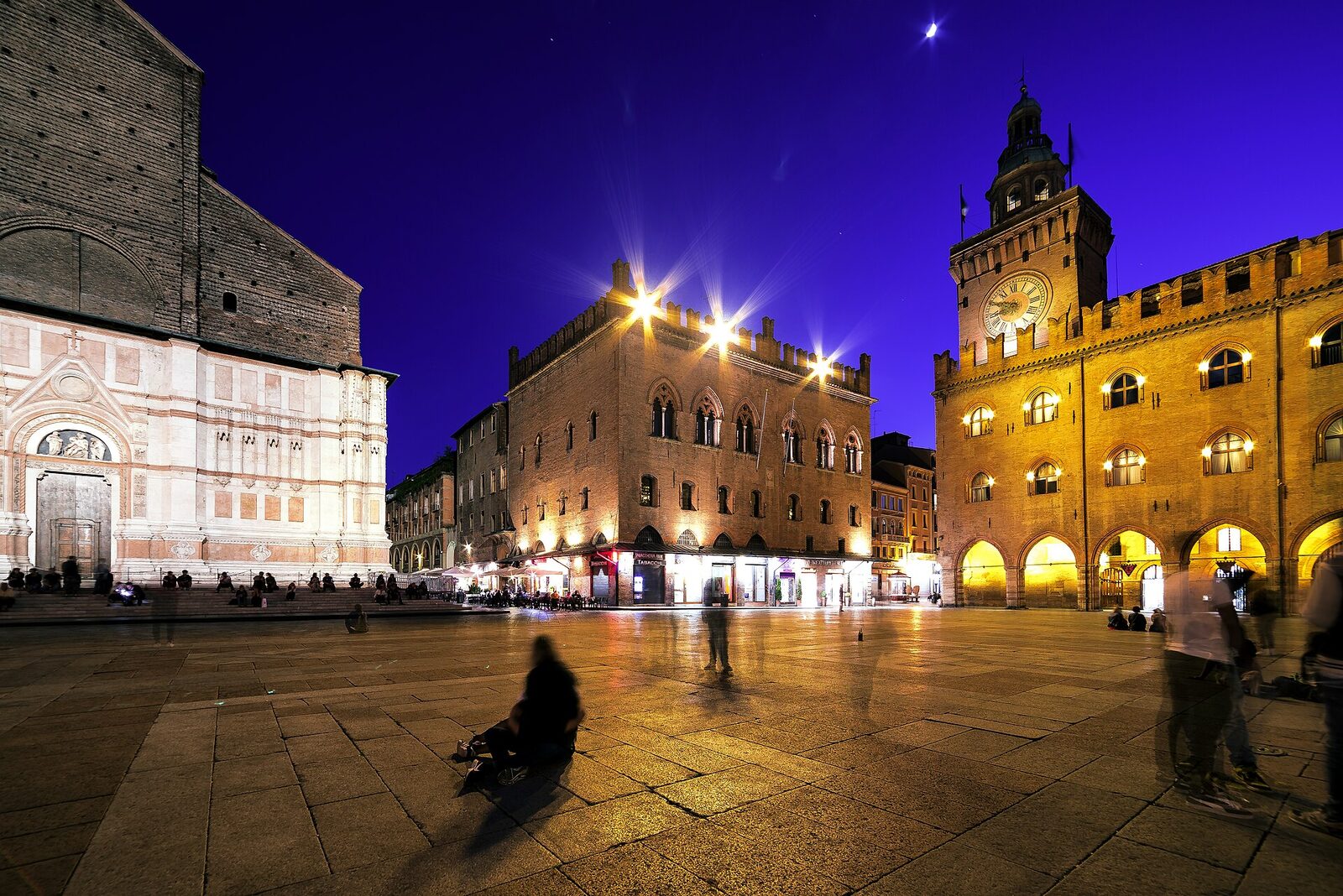
Piazza Maggiore, Bologna's main square
The civic heart of the city since the Middle Ages. One open square ringed by palaces, a giant church and a fountain, and the spot every Bologna walk starts from.
Piazza Maggiore is where you orient yourself in Bologna. Almost everything in the centro storico fans out from this one rectangle, and you'll cross it a dozen times without trying. Spend your first ten minutes here just turning in a circle: each side of the square is a different palace, a different century, a different story.
The square has been Bologna's gathering place since the 13th century, when the city cleared the space to hold its market and its government in one spot. It still does both jobs. On any given evening you'll find students sprawled on the steps, a film screening on the cobbles in summer, and old men arguing politics under the arcades. It's free, it's always open, and it never closes for the night.
- What it is
- Bologna's central civic square
- Cost
- Free · open-air, always accessible
- Time needed
- 20–40 minutes to take it in
- Best for
- Orientation, people-watching, photos
The buildings around the square
Stand in the middle and you're surrounded by four or five centuries of power. The huge brick mass on the south side is the Basilica di San Petronio, one of the largest churches in Europe and famous for a facade its builders never finished. Look up and you'll see the lower half clad in marble and the upper half left in bare brick, frozen mid-project for 500 years.
Opposite it stands the Palazzo del Podestà, the city's first town hall, built around 1200. On the west side is the Palazzo d'Accursio, today's town hall, a Gothic-and-Renaissance pile that also holds the city art collections and the Morandi rooms. The east flank is closed off by the Palazzo dei Banchi, a long arcaded screen designed by Vignola in the 1560s to tidy up the messy market lanes behind it. Tucked behind the Podestà is the Palazzo Re Enzo, named for a king's son who was kept prisoner here for 23 years.
The Crescentone (the raised platform)
That slightly raised stone platform in the middle of the square has a name: the Crescentone. It only went in during the 1930s, and locals nicknamed it after the crescenta, the savoury Bolognese flatbread it supposedly resembles. There's an unwritten rule that you don't walk across the very middle of it, though plenty of people do. It's also where the city holds concerts, markets and open-air cinema in the warmer months.
The whispering vault
Walk under the passage of the Palazzo del Podestà, the Voltone del Podestà, where four streets meet beneath the building. Stand facing one corner while a friend faces the diagonally opposite one, both of you nose-to-the-wall, and you can hear each other whisper clear across the noisy crossing. It's a quirk of the curved vault, and it's one of the things locals will smugly call a "secret of Bologna." Costs nothing, takes two minutes, always a hit with kids.
Local tip
Come back after dark. The palaces are lit, the day-trippers have gone, and the square fills with students from the oldest university in Europe. Grab a spritz at one of the cafe tables and watch the city use its own living room.
Right next door
Two steps off the square, in the little Piazza del Nettuno, is Giambologna's muscular Neptune Fountain from the 1560s, the most photographed bronze in the city. From there it's a flat five-minute walk east along Via Rizzoli to the leaning Asinelli tower, the one you can actually climb. Just behind San Petronio you'll find the Archiginnasio and its carved wooden anatomical theatre, and the warren of food stalls in the Quadrilatero market district starts barely 50 metres away.
If you've got more time, the atmospheric Seven Churches of Santo Stefano sit a short stroll east, and the covered Mercato di Mezzo food hall is the easiest place near the piazza to eat well on the go.
Getting there and getting oriented
The square is dead centre, roughly ten minutes on foot from the train station down Via dell'Indipendenza, and it's pedestrian-only, so you'll arrive by foot whatever you do. Every major street radiates from here, which makes it the easiest meeting point in town. For the full lay of the land, see how it all connects in our guide to getting around Bologna.
Piazza Maggiore itself needs no ticket. The paid sights are the ones around it, the tower climb and some of the palace museums, so plan those separately and use the square as your hub between them.
See the square with a local guide
A morning walking tour starts in Piazza Maggiore and ties the palaces, the whispering vault and the Quadrilatero together in a couple of hours. Most include skip-the-line access to the Asinelli climb.
Browse Bologna walking toursWhere to stay nearby
Book a room within the old walls and Piazza Maggiore is your doorstep. The centro storico has everything from boutique hotels in restored palazzi to simple guesthouses, and you'll walk to almost every sight. Compare options in our where to stay in Bologna overview, or jump straight to availability around the square.
Stay steps from the square
Hotels in Bologna's historic centre put you minutes from Piazza Maggiore, the towers and the market lanes.
Check central Bologna hotels