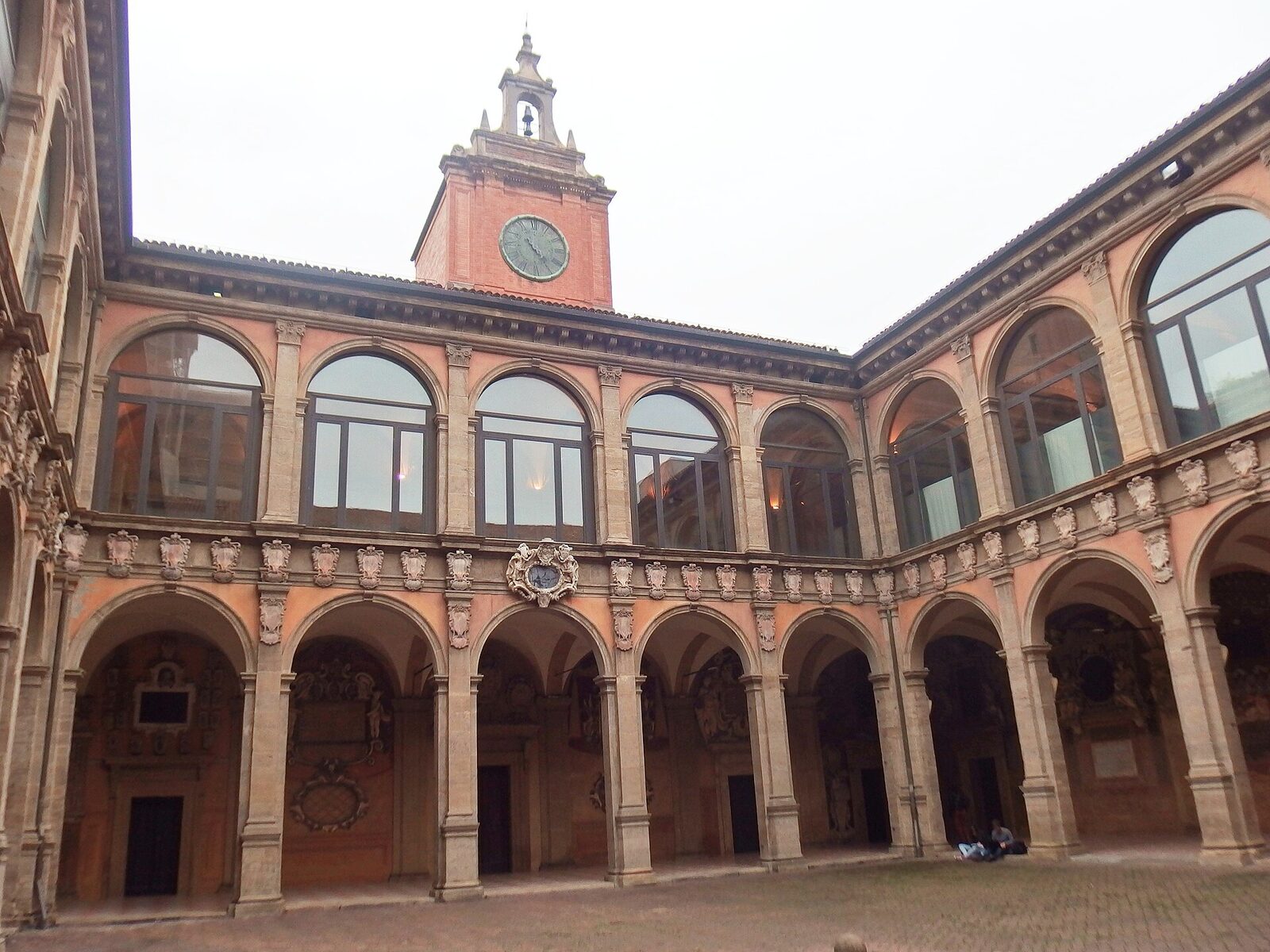
The Archiginnasio & its Anatomical Theatre
The first proper home of the University of Bologna hides a carved-wood dissection theatre and one of the largest displays of heraldry on earth, a minute from Piazza Maggiore.
Most people walk straight past the Archiginnasio on their way to San Petronio without realising what's behind the plain arcade. Step inside and you get a free courtyard plastered with thousands of student coats of arms, and upstairs, for a few euros, the spookiest, most beautiful room in Bologna: a wooden anatomical theatre where public dissections were once performed under a ceiling of statues.
- Built
- 1562–1563
- Theatre
- Completed 1637
- Coats of arms
- Around 6,000
- Ticket
- A few euros; courtyard free
What it is, in one minute
The Palazzo dell'Archiginnasio was put up in 1562–1563 to pull the scattered classrooms of the University of Bologna under one roof for the first time. The university itself dates to 1088 and is the oldest in continuous operation in Europe, but for its first few centuries lectures happened all over town. This building gave it a single seat, and it stayed the university's home until the early 1800s. Today it houses the city's municipal library, and two rooms upstairs are open to visitors: the anatomical theatre and the Stabat Mater hall.
The anatomical theatre
This is the reason to come. Finished in 1637, the Teatro Anatomico is a small amphitheatre carved entirely from spruce, with tiered benches ringing a central marble slab where cadavers were dissected in front of medical students. A canopy over the lecturer's chair is held up by two unsettling wooden figures known as the Spellati, the "skinned men," sculpted to show the muscles with the skin stripped away. The ceiling is studded with statues of famous physicians and a figure of Apollo. Public dissections here were as much theatre as medicine, often staged during Carnival with an inquisitor present to make sure nothing crossed the church.
One detail worth knowing: the room you see is a faithful reconstruction. A bomb hit this wing on 29 January 1944 and flattened it. The original wooden statues were dug out of the rubble and the theatre was rebuilt to the old design after the war, with the surviving carvings put back in their original places. It looks centuries old because most of what you're looking at is.
The Stabat Mater hall
Across the corridor is the old lecture hall of the jurists, a high room lined with coats of arms. It picked up its odd name in 1842, when Rossini's Stabat Mater got its first full Italian performance here under Donizetti. If it's open when you visit, it adds about ten minutes and a lot of grandeur to the ticket.
The coats of arms
Even if you skip the paid rooms, walk into the courtyard and look up. The walls, staircases and ceilings carry around 6,000 painted and carved coats of arms of the students and elected officials who passed through, going back to the 16th century. It's reckoned to be the largest wall display of heraldry anywhere. The courtyard, the grand staircases and the main corridors are free to wander, so this part costs you nothing.
Local tip
The courtyard and arcades are free and easy to miss. Even on a tight schedule, duck in for five minutes to see the heraldry and the staircases. The paid theatre is the highlight, but you don't need a ticket to get a sense of the place.
Visiting: tickets and hours
The anatomical theatre and Stabat Mater hall need a ticket, bought at the entrance, usually in the region of a few euros. Entry is often handled in timed slots, and on Saturdays, Sundays and public holidays you may need to book ahead, Sunday and holiday access in particular can be limited, so check the official hours before you go rather than turning up cold. The library areas keep their own schedule. The free courtyard is open through the day.
See it with a guide
A walking tour of the centro storico usually pairs the Archiginnasio and its theatre with Piazza Maggiore and the towers, with the history explained as you go and tickets sorted for you.
Browse Bologna walking toursGetting there
The Archiginnasio sits on Piazza Galvani, tucked right behind the Basilica di San Petronio, about a two-minute walk from the main square. It's an easy add-on to a morning in the centre. From here you're a short stroll from the market lanes of the Quadrilatero and the lean of the Asinelli Tower, and within range of the chapels at Santo Stefano. If you're chasing the city's history rather than just its food, this and the UNESCO porticoes are the two things to make time for.
Pair it with
The Archiginnasio slots neatly into a half-day on foot. Combine it with the Neptune Fountain on Piazza Maggiore, a graze through the covered food hall nearby, and a sit-down lunch, see where to eat in Bologna for the real tagliatelle al ragù, which is the dish the rest of the world wrongly calls spaghetti bolognese. Staying central makes all of this walkable; browse options for neighbourhoods to base yourself, and if you're moving around the wider region, the getting around guide and the list of day trips from Bologna will help.