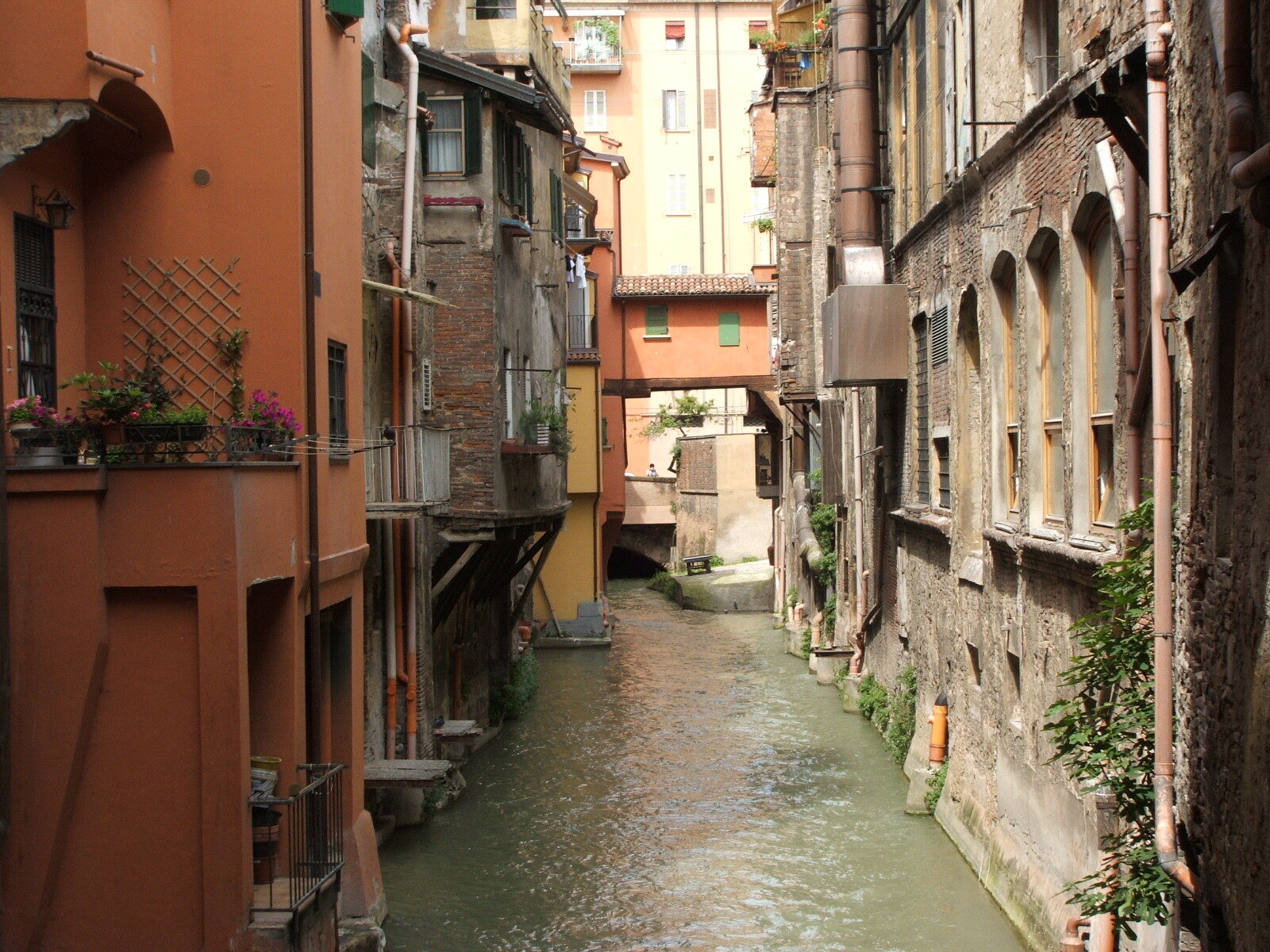
Bologna's hidden canals
Long before the porticoes made it famous, Bologna ran on water. A medieval canal network powered its mills and silk looms, and a few stretches still flow between the buildings if you know where to look.
Most people are surprised to learn Bologna ever had canals at all. There are no gondolas and no grand waterfront, but for centuries this was a water city, criss-crossed by artificial channels that turned mill wheels and fed one of medieval Europe's busiest silk industries. Most of that network now runs underground, hidden beneath the streets. A handful of stretches survive in the open, and finding them is one of the better free things to do in the centre.
- What it is
- Medieval canal network, mostly buried
- Best view
- Finestrella, Via Piella 25
- Cost
- Free, open-air, any time
- Time needed
- 20–40 min on foot
Why Bologna had canals
Bologna sits between two rivers, the Reno and the Savena, but neither runs through the centre. So from the 12th century the city built its own water system. The key piece is the Chiusa di Casalecchio, a diversion dam on the Reno completed in 1208 that is still working today, one of the oldest functioning hydraulic structures in Europe. It pushed river water into a feeder canal, the Canale di Reno, which split into smaller channels once it reached the city.
That water did real work. It drove dozens of mills, and above all it powered Bologna's silk-throwing machines, the big water-driven filatoi that made the city a textile heavyweight for 400 years. The canals were also a trade route. Goods moved from an inland port near today's Cavaticcio down the Navile canal toward Ferrara and the Po, linking Bologna to Venice and the sea. For a landlocked city, that was a serious advantage.
Where did the canals go?
They are mostly still there, just covered. As Bologna modernised in the late 1800s and again after the Second World War, the open canals were seen as smelly, awkward obstacles to traffic, so the city paved over them. The water still flows below the streets, but you would never know walking down Via Riva di Reno or Via Oberdan, both named after channels that now run beneath the asphalt.
Where to see the canals today
The Finestrella di Via Piella
This is the one everyone photographs, and for good reason. On Via Piella, at number 25, there's a small wooden window cut into an ordinary brick wall. Open the shutters and you look straight down a narrow stretch of the Canale delle Moline, lined with shuttered houses whose walls drop right into the green water. The resemblance to a Venetian back canal is what earned it the nickname "Little Venice." It's free, it's outdoors, and there's no gate, so you can come whenever you like. Full directions and photo tips are on the window on Via Piella guide.
Local tip
There are actually two openings on Via Piella, the famous window plus a wider gap a few steps along, and they get crowded with day-trippers around midday. Come early morning or late afternoon for a clear shot and softer light on the water.
Via Oberdan and Via Malcontenti
The same Canale delle Moline shows up again just around the corner. Walk to Via Oberdan and Via Malcontenti and you'll find more open stretches, viewed through railings and gaps between buildings rather than a single framed window. Piecing these spots together gives you a better sense of how the water once threaded through this whole quarter. It's a five-minute loop from the Finestrella.
Via Riva di Reno and Via Capo di Lucca
For a longer, less polished look, the area around Via Riva di Reno and Via Capo di Lucca has further open sections of the Canale di Reno. There's nothing curated here, no plaque or viewing window, which is part of the appeal. You're just seeing working water in the back of the city.
Fitting the canals into your day
The good news is the canal spots sit right in the heart of the centro storico, a short walk north of the main sights. The Finestrella is about five minutes from the leaning towers and a similar hop from the main square. You can string a canal stop together with the old market lanes and the food halls at Mercato delle Erbe without backtracking. It's one of the easiest detours to slot into a day of sightseeing around Bologna.
If you want the full story rather than just the photo op, the glass floor inside the Salaborsa library and the city's small water-history exhibits fill in how the system actually worked. And for the canals' modern cousin, the porticoes that replaced water as the city's signature, see our guide to Bologna's UNESCO arcades.
See the canals with a local guide
A handful of walking tours focus on hidden and underground Bologna, including the canals, the water gates and the buried waterways most visitors miss. It's the easiest way to understand what you're looking at.
Browse hidden Bologna toursPractical notes
- Everything here is free and open-air. There are no tickets and no fixed hours.
- You're looking at the canals, not cruising them. There are no regular boat trips through the centre.
- The water level changes with the season, so the canals can look fuller in spring than in high summer.
- Staying nearby puts all of this on your doorstep. See where to base yourself in the old town.