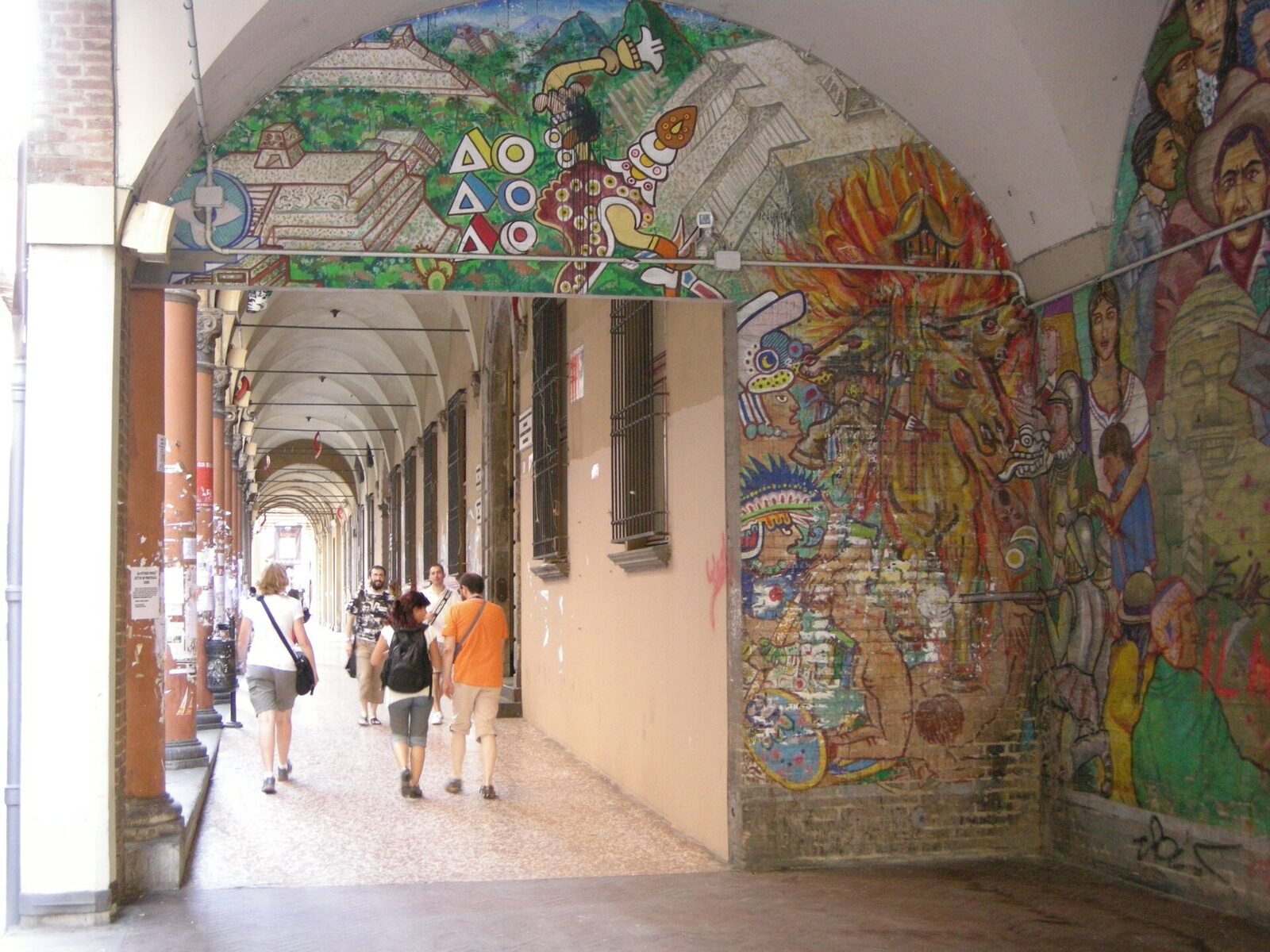
Bologna street art and murals
Behind the porticoes, Bologna runs one of Italy's most political and prolific urban-art scenes. Most of it is free, outdoors, and a short walk or bus ride from the centre.
Bologna takes street art seriously. The city has been an Italian capital of muralism for decades, fuelled by its student population, its activist squats and its festival circuit. You'll spot stencils and paste-ups in the old centre, but the big stuff lives out in the working-class neighbourhoods. Here's where to look and what the work actually means.
On this page
- Cost
- Free (it's outdoors)
- Best area to start
- Via del Pratello
- Biggest concentration
- Bolognina, San Donato
- Time needed
- Half a day to do it well
Via del Pratello: the easy first stop
If you only have an hour, walk Via del Pratello. It's a narrow, slightly scruffy bohemian street west of Piazza Maggiore, lined with osterie and bars, and the whole stretch doubles as an open-air gallery. The locals call it the Galleria d'Arte Pubblica Pratello, and the work runs for roughly 600 metres of shutters, doorways and walls. Come in the late afternoon when the bars open and you can mix a glass of wine with the art crawl. It's an easy add-on if you're already eating your way through the nearby market lanes of the Quadrilatero.
In the centre: the university quarter
The old town keeps its street art smaller and stencilled, since the historic core is protected. The richest patch is around Via Zamboni in the university district, where decades of student protest, posters and tags have layered up on the walls. Wander toward the old university and you'll pass political murals and paste-ups that change month to month. There's a second cluster near the station, between Via Marconi and Via Riva Reno.
Local tip
The street art and the porticoes go together better than you'd think. You can chain a Pratello art walk with the porticoed lanes of the centre, then read why those arcades matter on our guide to Bologna's UNESCO porticoes.
Bolognina and San Donato: the big murals
The serious work is outside the ring road. Cross the railway north of the station into Bolognina, a multicultural, formerly industrial neighbourhood that's become the heart of the scene. Look for the huge 3D lettering piece by DAIM on Via Fioravanti and large murals around Via Colonna by artists like Eron and DOES. Keep going to the San Donato and Porto districts and you'll find some of the largest walls in the city, many of them painted for the Frontier festival, which brought monumental muralism to these streets.
These neighbourhoods are ordinary residential areas, not tourist zones, so go in daylight and treat them like any working district. This is also where you'll feel why Bologna's art is so tied to its politics: a lot of it grew out of the city's squats and social centres.
DumBO: the regenerated train depot
For a more curated experience, head to DumBO (Distretto Urbano Multifunzionale di Bologna), a former rail freight yard near the station turned creative hub. It spreads across roughly 40,000 square metres of old warehouses and hosts large-scale murals, live painting, festivals and a rotating wall programme. It's a good rainy-day-adjacent option because there's food, events and shade alongside the art.
The Blu story: why some walls are grey
You can't talk about Bologna street art without Blu, the anonymous artist whose enormous, surreal murals once defined the city's outskirts. In 2016, Blu painted over twenty years of his own work in Bologna, rolling grey paint across his murals as a protest. The trigger was an exhibition called Street Art: Banksy & Co. at Palazzo Pepoli, which displayed murals that had been physically cut off the walls and shown indoors. Blu's argument was simple: street art belongs on the street and to the public, not boxed up and ticketed. The blank grey patches you'll notice around town are part of that story, and the debate it started about who owns public art is still live in Bologna.
CHEAP: the poster festival
Bologna's other signature is paper, not spray. CHEAP is a street poster art festival, running since the early 2010s, that pastes site-specific work onto a circuit of old advertising billboards across the centre. It's openly feminist and political, and it lands a new wave each year, usually in spring. If you spot a striking printed poster on a freestanding billboard rather than a wall, it's probably CHEAP. The older Cheap-style paste-ups and stencils blend into the Pratello and Zamboni walls too.
Seeing it for yourself
You can absolutely do this self-guided. Start at Via del Pratello, loop through the centre's stencil corners, then take a short bus or 15-minute walk into Bolognina for the big pieces. The work changes constantly, so half the fun is what's gone up since the last guidebook. If you'd rather have the context and the backstories filled in, a local guide on foot or by bike will get you to the murals that are easy to miss and explain the politics behind them.
Want the stories behind the walls?
Guided street-art walks and bike tours run from the centre out to Bolognina and back, covering the Blu murals, the CHEAP posters and the social-centre history you won't get from a map.
Find Bologna street-art toursWhere it fits in your trip
Street art slots neatly into a second day, once you've ticked off the icons. Pair a Pratello-and-Bolognina morning with a climb up the surviving medieval tower for the rooftop view, or with the cloistered calm of the Seven Churches complex. For a contrast in scale, the carved-wood anatomical theatre at the Archiginnasio shows the old, official face of Bolognese art, while the canal window at the Finestrella on Via Piella is a quick photo stop on the way north toward Bolognina.
Hungry after all the walking? Bolognina and Pratello are both strong for cheap, genuine food, so check our guide to eating in Bologna. Working out logistics? See how to get around the city, where to base yourself, and which day trips are worth the train. Browse more in the full round-up of things to do in Bologna.