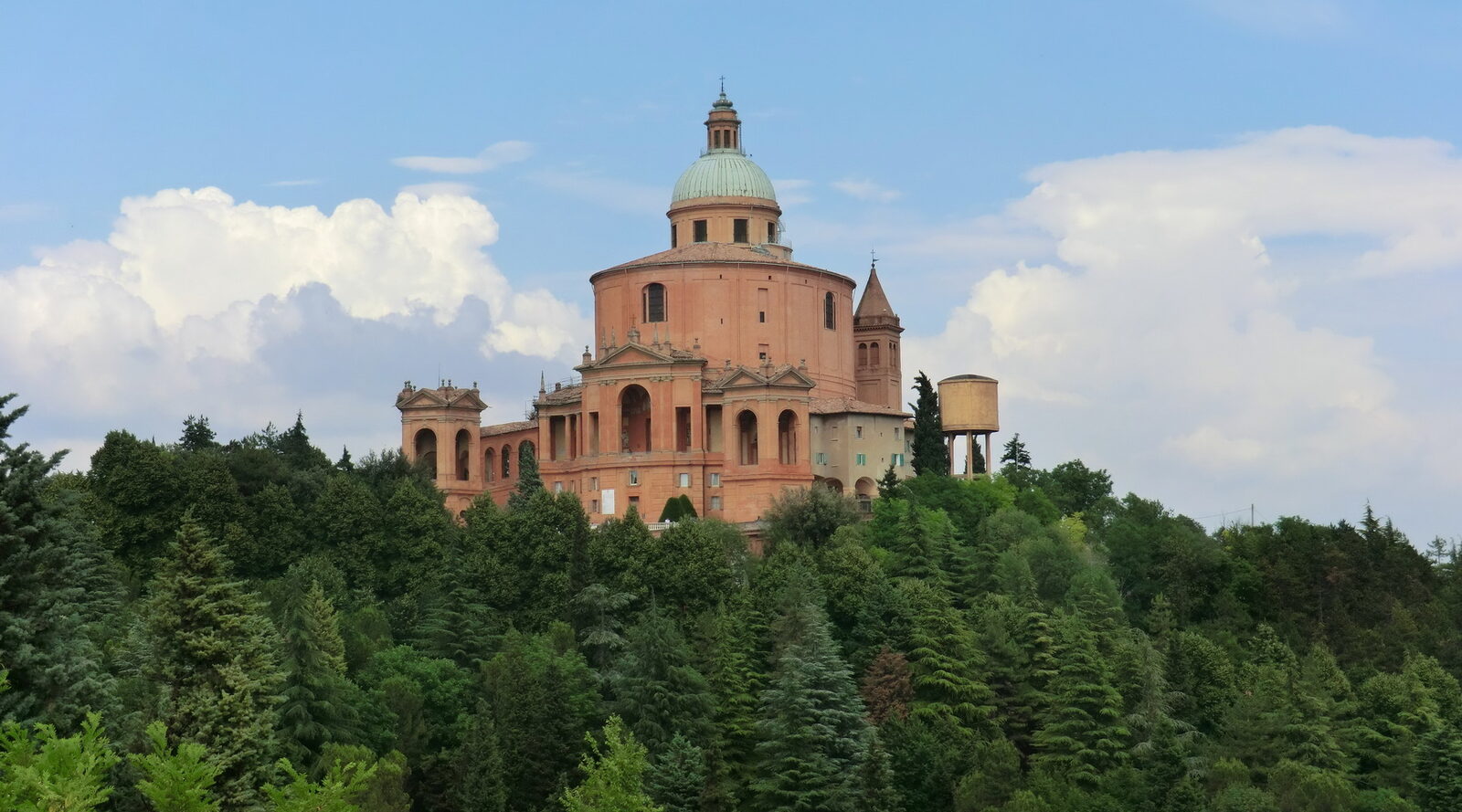
The Sanctuary of the Madonna di San Luca
The domed Baroque church on Colle della Guardia is Bologna's most-loved landmark, visible from miles away, reached by the longest covered walkway on earth.
San Luca is the church Bolognesi point to when they say they're home. It crowns a wooded hill southwest of the centre, about 300 metres up, and you can see its salmon-pink dome from the motorway, the airport and half the rooftops in town. Most visitors come for two things: the venerated icon inside, and the view back over the city and the Apennines. Getting up there is half the experience.
- Built
- 1723–1757, Baroque
- Architect
- Carlo Francesco Dotti
- Height
- ~300 m above the city
- Entry
- Free (church)
What you're looking at
The full name is the Santuario della Beata Vergine di San Luca. The current church went up between 1723 and 1757 to a design by the Bolognese architect Carlo Francesco Dotti, replacing older chapels that had stood on the hill since the Middle Ages. It's a confident piece of Baroque: an elliptical plan, a big central dome and a curved facade that reads beautifully against the sky as you climb toward it.
Inside, the focus of all the devotion is a small Byzantine icon of the Madonna and Child, traditionally said to have been painted by Luke the Evangelist himself. The honest version is that it's a 12th-century Byzantine work, brought to Bologna by a Greek pilgrim and kept on the hill ever since. It sits above the main altar, framed by polychrome marble, gilded stucco and chapels hung with paintings by Bolognese masters including Guido Reni and Guercino. You don't need to be religious to find it moving.
The walk up: the world's longest portico
The reason San Luca is special isn't just the church. It's how you get to it. A continuous covered walkway, the Portico di San Luca, runs 3.8km from the edge of the centre right up to the sanctuary doors, climbing the hill under 666 arches without a single break in the roof. It was built between 1674 and the 1700s so that the icon could be carried up and down in procession come rain or shine, and it's the showpiece of Bologna's UNESCO-listed porticoes.
The walk starts at Porta Saragozza and is flat and easy for the first stretch. After the Arco del Meloncello it turns into a proper climb, roughly 2km of uphill arches and steps. Allow somewhere between an hour and an hour and three-quarters at a steady pace, more if you stop for photos. It's shaded the whole way, which is a gift in a Bologna summer.
Local tip
Walk up in the morning when it's cool and quiet, then take the little tourist train or the bus back down to save your knees on the descent. Mornings also give you the clearest air for the view at the top. Wear real shoes, the second half is a workout, not a stroll.
Getting there without walking
Not everyone wants to climb. The easiest option is the San Luca Express, a road train that leaves from Piazza Maggiore (near the Neptune Fountain), loops through town and grinds up the hill to the sanctuary. A return ticket runs around €10 for adults, less for children, and the round trip takes about an hour. Buy it on the spot or book ahead in high season.
By public transport, take city bus 20 to the Villa Spada stop on Via Saragozza, then change to bus 58, which winds up to the church. It's cheaper than the tourist train but slower and a little fiddly. Check current routes locally, since the hill buses don't run as often as the central lines. Either way, the classic move is to ride up and walk down, or walk up and ride back.
The view
From the terrace beside the sanctuary you get the postcard: the whole of "la Rossa" spread out in terracotta below, the Asinelli tower poking up out of the centre, the rooftops of the main square, and the green wave of the Apennine foothills behind you. On a clear day it's one of the best free things you can do in the city. There's a small bar near the top if you need water or a coffee before heading back.
Skip the climb with a San Luca tour
Guided trips and the scenic road train take you up to the sanctuary and back with commentary along the way, so you keep the view and lose the leg burn.
See San Luca tours & ticketsPractical notes
- Entry to the church is free. Hours follow worship times and shift by season, so check official hours before a long trip up.
- It's an active place of devotion. Dress modestly (shoulders and knees covered) and keep voices down inside.
- There are no big crowds and no ticket queues, which makes it a calm contrast to the towers and the centre.
- Combine it with the portico walk for a half-day; the whole thing is one experience, not two.
Nearby and related
San Luca pairs naturally with the rest of Bologna's sights worth your time. Back in the centre, see the unfinished giant of San Petronio, get lost in the linked chapels of the Seven Churches, and duck into the medieval market lanes of the Quadrilatero for lunch. To understand how Bologna built so many covered walkways in the first place, read the porticoes guide, then plan the rest of your route with getting around Bologna and a base from hotels near Porta Saragozza.