Rimini day trip from Bologna
Most people picture Rimini as a wall of sun loungers. There's a beach, yes, but the old town hides a Roman arch older than the Colosseum, a Renaissance temple and Fellini's hometown.
Rimini sits about an hour down the line from Bologna, which makes it one of the easiest seaside escapes in Emilia-Romagna. Skip the resort strip and head straight for the centro storico, where the Romans landed first and the film director Federico Fellini grew up. You can see the lot on foot in an afternoon and still get your feet in the Adriatic.
- Distance
- ~120 km southeast
- Train time
- About 1 hour (regional)
- Frequency
- Very frequent, all day
- Best for
- Roman history, beach, Fellini
Getting from Bologna to Rimini
This is one of the simplest train runs out of Bologna. Regional trains (Trenitalia's Regionale) leave Bologna Centrale through the day and reach Rimini in roughly an hour, with the quickest a little under that. They run very frequently, so you don't need to plan around a strict timetable. Faster Frecce and Intercity trains shave a few minutes but cost more and aren't worth it for this short a hop. Buy a regional ticket, validate it if it's a paper one, and go.
Rimini's station sits right at the edge of the old town. Everything below is a 10 to 20 minute walk from the platforms, so there's no need for buses or taxis unless you're heading way down the beachfront.
Local tip
Regional fares are a fixed price and don't change with demand, so there's no advantage to booking days ahead. Just turn up, grab the next departure and validate before boarding. Going in summer? Travel early to beat the day-tripper crowds heading to the same coast.
The Roman town: Arch of Augustus and Tiberius Bridge
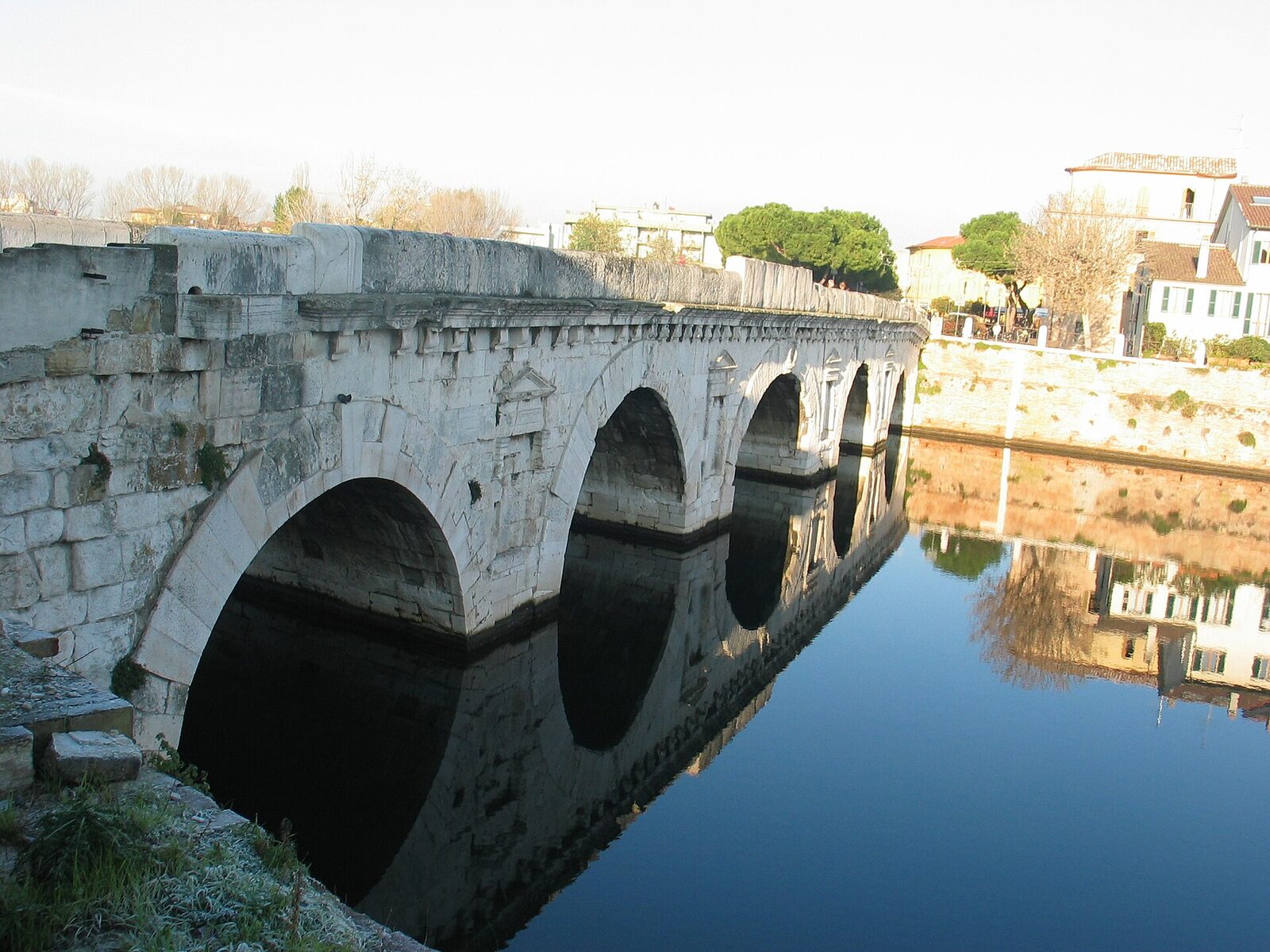
Rimini began as Ariminum, the Roman colony where the Via Flaminia from Rome met the Via Emilia that still runs through Bologna. Two monuments survive from that era and both are free to walk up to. The Arch of Augustus (Arco d'Augusto) went up in 27 BC, which makes it the oldest surviving Roman arch in northern Italy. At the other end of the old town, the Tiberius Bridge (Ponte di Tiberio) still carries foot traffic across the water after roughly two thousand years. Between them runs the old Roman main street, ending at Piazza Tre Martiri, once the forum where, by tradition, Julius Caesar addressed his troops after crossing the Rubicon nearby.
Tempio Malatestiano
The single most surprising building in town is the Tempio Malatestiano, Rimini's cathedral. In the 15th century the local strongman Sigismondo Pandolfo Malatesta hired the Florentine architect Leon Battista Alberti to wrap a Gothic church in a marble Renaissance shell modelled on a Roman triumphal arch. Inside you'll find work associated with Piero della Francesca and Giotto, plus carved elephants and zodiac signs that feel more pagan than pious. Entry is usually free, though hours shift around services, so check before you build your day around it.
Fellini's Rimini
Rimini was the home town of Federico Fellini, and the city leans into it. The Fellini Museum spreads across three sites a short walk apart: the medieval Castel Sismondo fortress, the restored Cinema Fulgor where he watched films as a boy, and the square between them. It's a playful, dreamlike museum rather than a dusty archive, and it's the main paid attraction in town. Tickets are sold on site or online, so check current hours and book ahead in high season if you want a guaranteed slot.
From there, cross the Tiberius Bridge to Borgo San Giuliano, the old fishermen's quarter where Fellini's family lived. It's a maze of pastel houses and lanes covered in murals, many of them scenes from his films. This is the prettiest, quietest corner of Rimini and a good spot for lunch.
See Rimini and the coast with a guide
Short on time or want the Fellini and Malatesta stories filled in? Guided tours and day trips from the area bundle the old town highlights so you're not navigating opening hours yourself.
Check Rimini tours & ticketsThe beach: worth it or not?
Rimini's beach is enormous, sandy and famous, but it's also wall-to-wall private bagni (beach clubs) charging for sunbeds and umbrellas in summer. If you just want a quick paddle and a gelato, there are free public stretches, and the seafront is a 15-minute walk from the old town. Honestly, the beach is a bonus here, not the reason to come. Go for the Roman and Renaissance core, then dip your toes in on the way back to the station. In shoulder season the coast is calmer and the beach clubs quieter, which suits a day trip better than peak August.
How to spend the day
A clean half-day loop: walk from the station to the Arch of Augustus, up the old Roman street to Piazza Tre Martiri, over to the Tempio Malatestiano, then Castel Sismondo and the Fellini Museum. Cross the Tiberius Bridge into Borgo San Giuliano for lunch, then cut down to the seafront before catching a train back. With the frequent service you can stay loose and leave whenever you've had enough sun.
Where Rimini fits among Bologna's day trips
Rimini pairs the coast with serious history, which sets it apart from the food-first trips. If you're after cured meats and Parmigiano instead, point yourself at Parma or balsamic-soaked Modena, both core stops on the Food Valley circuit. For art, the Byzantine mosaics of Ravenna are just up the same coast. Want another Adriatic curiosity? The canal town of Comacchio, the little Venice of the Po delta, makes a good pairing. And if you'd rather climb to a country with no sea at all, the cliff-top republic of San Marino sits just inland from Rimini.
All of these run on the same easy logic. See which ones need nothing more than a ticket and a platform on our roundup of Bologna day trips you can do by train, then come back to the full list of day trips from Bologna to plan the rest.
Back in town, line up an evening of tagliatelle al ragù (the real Bolognese, never spaghetti) and book a central base on our where to stay guide so you're a short walk from the station for the next outing.